Lady’s Bedstraw
Galium verum
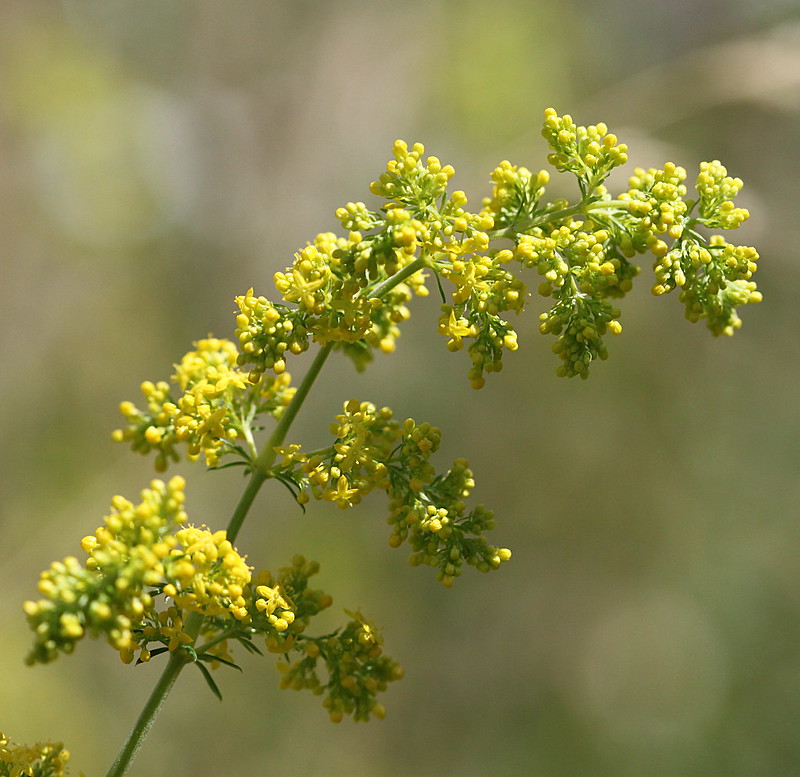
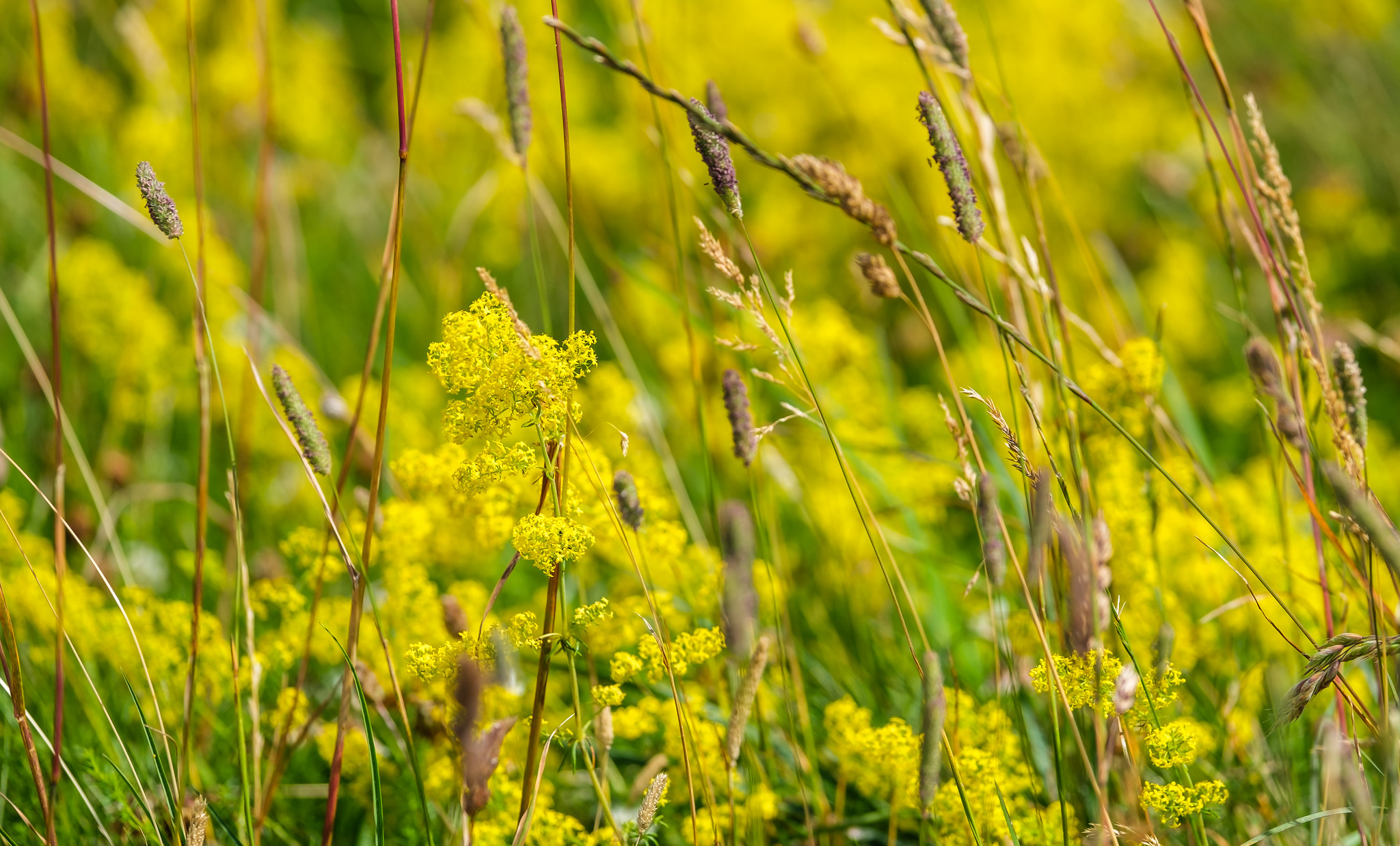
Lady’s Bedstraw is a low scrambling plant native to Europe and Asia. It is most at home on chalk downs, grasslands, heathland and coastal areas. Its bright yellow flowers are in abundance throughout the summer and start to tail off when the leaves begin falling from the trees. It can grow up to about 60cm/2 foot tall. You’ll find it by looking out for shocks of yellow across a landscape. Considering that it can cover fairly substantial areas you might well see it flashing past from a train window. Its leaves consist of whorls, an arrangement that radiates from a single point, rather like the spokes of a wheel. Each whorl contains 8-12 leaves each with pointed tips.
There is a local gardener who dumps his green waste in the woods, often this contains Lady’s bedstraw. I know because his composting piles over give off the scent of new-mown hay, a classic lady’s bedstraw smell. According to Richard Mabey in Flora Britannica its name most likely arose from the old custom of including it in straw mattresses. Alternative schools of thought suggest that herbalists administered it as a sedative for women in childbirth. I’m guessing gas and air and the epidural trounced this use!
Using Lady’s Bedstraw for cheese making
A relative of woodruff Galium odoratum and cleavers Galium aparine, lady’s bedstraw has found it’s way into many kitchens, mainly as a substitute for rennet when making cheese. As herbalist Monica Wilde has pointed out, “The history of the bedstraws with cheese goes back quite a way. The genus name Galium is derived from gala, the Greek word for milk. Goosegrass (Galium aparine) was said to be used to sieve curds and whey – its ability to stick to itself made it a perfect primitive sieve for Greek shepherds. One of the common names is ‘milk sweet’. Apparently, all the Galiums can be used for rennet to some degree.” She also offers some recipes for making cheese using wild plants. Interestingly, bedstraw was the plant of choice when making cheese that needed some colour, cheeses like Double Gloucester.
It’s worth taking note from Miles Irving, a fellow forager who doesn’t mince his words, on the efficacy of using lady’s bedstraw as a rennet. In The Foragers Handbook he states, “There are many accounts of people finding it quite useless for this purpose. It is more likely to have been used to flavour the cheese”. If you have experimented with it please comment below and let me know.
Lady’s Bedstraw as a medicine
This perennial has been a very familiar asset in the herbalist’s armoury, helping with a whole manner of ailments including, kidney stones, gout, to stop bleeding and to aid the liver. Maria Treben the author of, Herbs from god’s pharmacy and a renowned Austrian herbalist suggests that it should be used fresh and that “When suffering from a disorder of the lymphatic system, one should drink this tea daily”.
Maria Treben also found some evidence to support the notion that bedstraw can aid those suffering from cancer of the tongue. She suggests that some of her patients having gargled with it, reported good health after a matter of weeks.
Another Austrian author and plantsman Richard Willfort suggests that drinking bedstraw tea is an excellent remedy he also suggests mixing bedstraw with butter as a remedy for cancerous growths and skin cancer. Although, Dr. Heinrich Neuthaler in “The Herb Book” rather angrily disagrees: “The white flowering Bedstraw is recommended for cancer in some districts even today – a nonsense that cannot be opposed strongly enough.” As with all treatments, ancient and modern, it is always worth getting a second opinion!
Other uses for Lady’s Bedstraw
Beyond the kitchen and the pharmacy, the dyer might well seek out the delights of lady’s bedstraw. The roots have been used for the colour red. If you are looking for a vivid red this isn’t your plant as bedstraw has a lower concentration of dye than many red producing plants (such as Madder or St Johns wort). This is perfect if you are after paler reds. Often, therefore, it was used in the more remote places where other plants were unavailable.
There is rich tradition, for example, of using it for dyeing woolen items on the Hebrides. It was always foraged, attempts to cultivate have been less than satisfactory! Its tiny roots mean you have to cultivate huge areas in order to obtain any workable amount of dye.
My experience using Bedstraw is to give a little flavour to drinks. Just a few sprigs added to a Gin and tonic as a garnish can infuse it with a delightful floral flavour that is hard to place. It is well worth seeking out this sometimes elusive herb.